
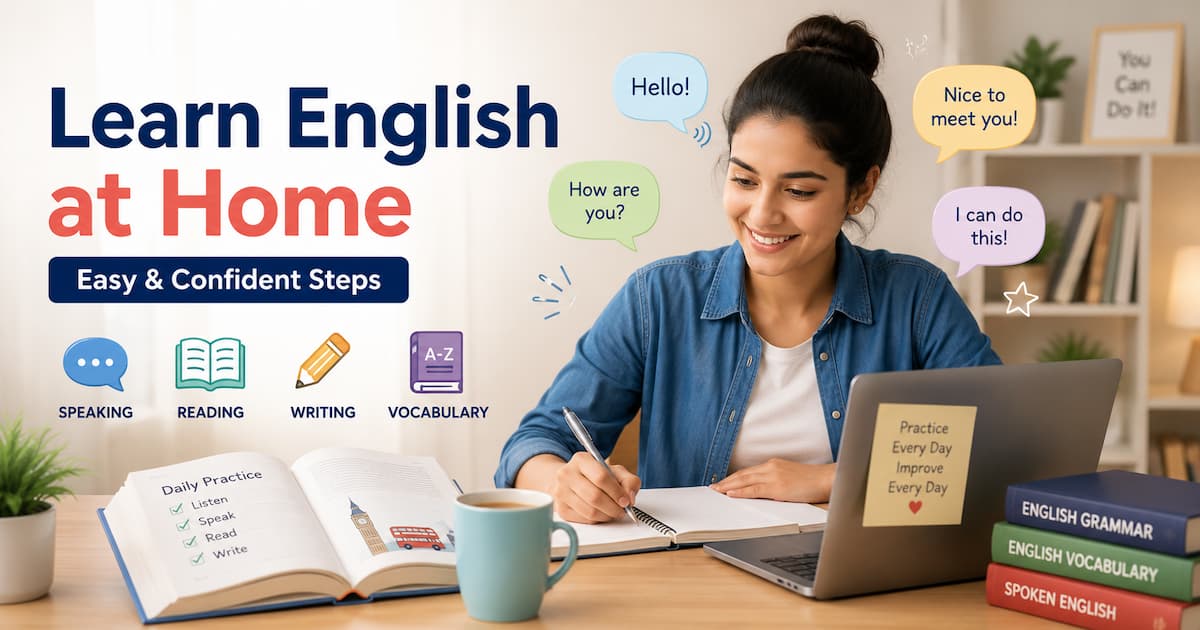
You want to speak fluent English, but you don’t have a speaking partner or the budget for expensive academies. I know exactly how that feels. As a high school student managing englishhubplus.com, I built my communication skills entirely from home using free tools, daily self-talk, and a strict routine. I never stepped into a paid language center, and you don’t need to either.
Most beginners stay stuck for years because they treat English like a subject to be memorized rather than a skill to be practiced. They cram complex grammar rules and memorize long, disconnected vocabulary lists. However, linguistic science shows that fluency isn’t built through memorization—it is acquired through consistent exposure and physical habit.
To actually learn English at home, you need to shift your focus to three core principles:
- Comprehensible Input: Reading and listening to material where you naturally understand 80% of the context without constantly reaching for a dictionary.
- Immersive Environment Design: Restructuring your digital and physical surroundings so your brain is forced to process English during normal daily tasks.
- Active Output: Physically training your mouth and facial muscles to produce target language sounds through specific solo drills, eliminating the need for a native speaking partner.
This guide strips away the academic fluff. You are going to learn the exact step-by-step framework to build a 30-minute daily habit that transforms how you absorb and speak the language. Here is exactly how to start.
How to Learn English Speaking at Home for Beginners
To learn English speaking at home for beginners, build an immersive environment and practice daily self-talk. Change your device settings to English to learn functional vocabulary, label household items with sticky notes, and narrate routine actions out loud to train your brain without needing a partner.
Forget memorizing complex grammar rules. Starting your journey by studying the past perfect continuous tense causes frustration and kills your momentum before you even begin. Fluency is not about knowing every rule; it is about recalling the right words instantly.
Master the Core 1,000 High-Frequency Words
Linguistic research shows that the top 500 to 1,000 high-frequency words cover roughly 80% of daily conversational English. Once you know them, you have the building blocks to communicate basic ideas immediately.
The Simple Way: Search for the “Oxford 3000” list online. Ignore formal academic words for now. Focus entirely on daily action verbs (scroll, cancel, skip, submit) and relevant nouns (screen, schedule, anxiety, habit).
The Difficult Way (Maximum Retention): Stop translating these words into your native language. If you see the word “Overwhelmed,” do not translate it to Urdu; physically attach it to that stressed feeling before an exam. If you learn the word “Scroll,” picture your thumb swiping on TikTok. Use a Spaced Repetition System (SRS) app like Anki to test your memory right before you are about to forget a word, locking it into your brain permanently.
You do not need to move abroad to surround yourself with English. You create an immersive environment by forcing your brain to interact with the language during your normal routine
Build a 3-Tier Immersive Environment
Tier 1 (Easy) – The Sticky Note Method: Grab a pack of sticky notes and label the physical items in your room—charger, wardrobe, sneakers, backpack, skincare. Leave them there for a month. Every time you grab your charger, say the word out loud.
Tier 2 (Medium) – The Digital Takeover: Change your smartphone, laptop, and social media menus to English. It will feel awkward for the first three days, but you will naturally associate English words like “mute,” “drafts,” “privacy,” and “notifications” directly with their functions instead of translating them.
Tier 3 (Difficult) – The Algorithm Shift: Social media algorithms serve you what you interact with. Purposely search for, watch, and like English-only content on YouTube, TikTok, and Instagram. Whether you are into streetwear fashion hauls, study vlogs, or tech reviews, only consume them in English. Stop engaging with content in your native language for 30 days. Your feed will transform into a virtual English-speaking zone.
The Daily Self-Talk Progression
If you do not have a speaking partner, you must talk to yourself. It sounds a little crazy, but it is the fastest way to force your brain to retrieve vocabulary in real-time under zero pressure.
Level 1 (Simple Action Narration): Narrate your physical actions using the present continuous tense. As you get ready for the day, say out loud, “I am packing my bag. I need to plug in my phone. I am picking out my outfit.”
Level 2 (Problem Solving): When a minor annoyance occurs, process it out loud in English. “Where did I leave my AirPods? I literally just had them. Why is my Wi-Fi lagging so badly right now?”
Level 3 (Abstract Thinking): This is the toughest level. Try to explain a feeling or an opinion to an empty room. “I am completely burned out from studying for boards today. Also, I don’t get why everyone is hyping up that new Netflix series, the main character is incredibly toxic.”
By pushing through these self-talk levels, you bridge the massive gap between reading English on a screen and physically speaking it in real life.
How to Learn Fluent English at Home: The Shadowing Technique
You can learn fluent English at home by mastering the shadowing technique. Listen to a native speaker’s audio and repeat it immediately within one second. This audio repetition drill forces your mouth to match the correct rhythm and pronunciation, building muscle memory for fast, natural speech.
Passive listening will not make you fluent. Having an Emma Chamberlain vlog or a true-crime podcast playing in the background while you finish your physics homework is great for exposure, but it is a trap to think this alone builds fluency. Active listening—and mimicking—is where actual progress happens.
Why You Need a “Target Voice” (The Easy Start)
Do not try to sound like a 60-year-old news anchor reading a teleprompter. That is not how your generation speaks. Pick a “target voice”—a creator, actor, or podcaster whose vibe and speaking style you actually like and want to copy. It could be Zendaya in an interview, a tech reviewer like MKBHD, or a lifestyle vlogger.
Finding a voice you connect with makes the repetition feel less like a chore and more like acting.
The 3-Step Shadowing Protocol
To execute the shadowing technique correctly, do not just blindly repeat words. You need a system to break down the audio.
Step 1: The 0.75x Speed Hack (Easy): Open a short YouTube video (under 2 minutes). Turn the playback speed down to 0.75x and turn on the English closed captions (CC). Listen to one single sentence. Pause the video.
Step 2: The Emotion Match (Medium): Repeat the sentence exactly as the speaker said it. Copy their pitch, their pauses, and their exact emotion. If they said the sentence with sarcasm, you say it with sarcasm. If they sounded annoyed, you sound annoyed. Do not just read the text; mimic the exact sound wave.
Step 3: The Blind Shadow (Difficult): Once you are comfortable, turn the subtitles off and put the speed back to 1x normal speed. Now, do not pause the video. Try to speak over the person, staying exactly a split-second behind them. This forces your brain to bypass the reading phase and connect hearing directly to speaking.
Rewiring Your Facial Muscle Memory
Speaking a language is highly physical. Your native language—whether it is Urdu, Pashto, or Punjabi—uses specific mouth, jaw, and tongue muscles. English requires entirely different movements (like the harsh “th” sound or the soft “r”).
When you first start shadowing, your mouth will stumble. You will trip over your own tongue, and it will feel extremely cringe-worthy. Push through it. Shadowing physically trains your facial muscles to produce target language sounds without hesitation.
If your jaw literally feels tired after ten minutes of shadowing, you are doing it right. It means you are finally using muscles you have ignored for your entire life. Spend ten minutes a day doing this, and you will notice a drastic improvement in your accent, speaking speed, and confidence within a single month.
How to Learn English Speaking and Writing at Home Together
To learn English speaking and writing at home simultaneously, keep a simple daily diary. Write two new words and three short sentences about your day every evening. Read these entries out loud in front of a mirror to build basic English conversation skills and overcome shyness.
Writing solidifies what you learn, and speaking activates it. But if you try to write a massive, perfectly structured essay every night after finishing your school homework, you will quit by day three. You need a frictionless system that takes less than five minutes.
The “Micro-Journal” Method (Writing)
Forget the traditional “Dear Diary” format. Think of this as a quick brain dump. You can use a physical notebook or just open the Notes app on your phone.
The Easy Way (The 3-Bullet Rule): Do not overcomplicate your grammar. Stick to the absolute simplest sentence structure: Subject + Verb + Object. Write exactly three sentences about what actually happened today. “I studied biology for two hours. My friend canceled our plans. The dinner was spicy.” That is it. You just practiced past-tense English organically.
The Medium Way (The Vocabulary Plug-in): Take two new high-frequency words you learned that day and force them into your three sentences. If you learned the words “exhausted” and “postpone,” use them. “I was completely exhausted after school. I had to postpone my study session.” This proves you actually know how to use the words in context, rather than just memorizing a dictionary definition.
The 2-Minute Mirror Routine (Speaking)
Once the words are on paper, they are useless unless you can actually say them out loud. This is where you bridge the gap between knowing a word and having the confidence to use it in a real conversation.
Step 1: The Awkward Read-Aloud (Easy): Stand in front of your bedroom mirror. Read your three sentences out loud. It will feel incredibly awkward. You might even cringe at your own voice. Do it anyway. This physical act eliminates the fear of hearing yourself speak a foreign language.
Step 2: The Eye-Contact Rule (Difficult): Do not just stare at your notebook. Read the first sentence in your head. Then, look up, make direct eye contact with yourself in the mirror, and say the sentence out loud. This trains you to maintain eye contact while speaking English—a major struggle for most beginners who tend to look at the floor when they get nervous.
The “Fake Voice Note” Hack
If the mirror routine feels too weird, use the digital equivalent.
Open WhatsApp and create a private group with just yourself. Every night, hit the microphone icon and record a 30-second voice note in English summarizing your day. Treat it exactly like you are sending an audio message to your best friend complaining about a tough assignment or talking about a new video game.
Listen back to the audio immediately. You will instantly catch your own mistakes—like where you paused for too long, or where you accidentally used an Urdu word as a filler. This builds massive self-awareness and acts as a free, daily speaking test. Here this guide gives you a list of daily vocabulary for beginners.
How to Learn English Quickly at Home: The 30-Minute Habit
To learn English quickly at home, commit to a strict daily 30-minute habit focused on comprehensible input. Spend ten minutes on contextual translation with graded readers, ten minutes doing shadowing exercises, and ten minutes writing in your diary. Consistency accelerates fluency much faster than weekend cramming.
Binge-studying grammar for four hours on a Sunday afternoon is a massive trap. It burns you out, and by Wednesday, you have forgotten most of it anyway. A strict, non-negotiable daily 30-minute block wins every single time because it builds a physical and mental routine.
The Rule of “Comprehensible Input”
You cannot learn quickly if you are constantly frustrated. If you try to read a complex political article on the BBC or watch a Shakespearean play, you will get overwhelmed and quit.
You need comprehensible input—reading or listening to material where you naturally understand about 80% of what is happening without reaching for a dictionary.
The Easy Approach (Simplified English): Seek out A1 or A2 graded readers. These are short stories specifically rewritten using only the top 1,000 core English words. You can also follow social media accounts or YouTube channels that teach “Simplified English” concepts, where creators deliberately speak slower and use highly accessible vocabulary.
The Difficult Approach (Contextual Translation): When you are reading a story and encounter an unknown word, do not stop to look it up immediately. This ruins your flow. Instead, look at the rest of the sentence and guess what the word means based on the context. If the sentence says, “The boy was so famished that he ate three burgers,” you can easily guess that “famished” means very hungry. This trains your brain to handle real-world conversations, where you cannot hit pause to translate a word when someone is talking to you.
The Ultimate 30-Minute Daily Breakdown
Stop guessing what to study each day. Follow this exact 30-minute daily schedule to guarantee rapid progress without feeling overwhelmed.
- Minutes 0-10: Active Input (Reading & Vocabulary)
- Read a short article, a page of a graded reader, or a high-quality blog post in Simplified English. Do not just skim it. Identify two new words, guess their meanings through context, and quickly write them down in your notes app.
- Minutes 11-20: Audio Repetition (Shadowing Drill)
- Pull up a short YouTube video from your target voice (a vlogger, actor, or creator you like). Put the speed on 0.75x if needed. Spend these ten minutes aggressively shadowing their dialogue. Mimic the exact pitch, rhythm, and mouth movements.
- Minutes 21-30: Solo Output (The Micro-Journal)
- Open your notebook or the private WhatsApp group you created for yourself. Spend the last ten minutes writing three simple sentences about your day, incorporating the two new words you found earlier. Finally, look in the mirror or hit record on your phone, and speak those sentences out loud.
This 30-minute loop covers reading, vocabulary acquisition, pronunciation, writing, and speaking all in one sitting. It is highly efficient, zero-cost, and completely manageable even if you have a massive stack of school assignments waiting for you.
How to Learn English at Home Step by Step
To learn English at home step by step, start by absorbing comprehensible input through reading short stories. Next, practice passive listening by watching movies with subtitles. Finally, transition to active audio repetition drills to lock in your pronunciation before attempting basic English conversation with others.
Jumping straight into speaking with native speakers terrifies most beginners. A phased approach removes that anxiety entirely.
Phase 1:
Controlled Input. Spend your first month focusing exclusively on reading graded readers and identifying high-frequency words. Your goal is simply to recognize words in context, not to produce them perfectly.
Phase 2:
Auditory Processing. Start watching movies or TV shows with subtitles. Keep the audio in English and the subtitles in English. This trains your brain to connect the written word with its spoken sound.
Phase 3:
Solo Output. Introduce audio repetition drills. This is where you pause the video and repeat the dialogue. You do this alone in your room.
By the time you actually have a real conversation, your brain has already processed the sentence structures hundreds of times.
The Best Way to Learn English at Home for Free
The best way to learn English at home for free is by leveraging YouTube channels, free podcast apps, and open-source reading materials. You can learn English by yourself entirely through free comprehensible input without ever paying for a premium language course or private tutor.
Stop looking for a magic app that costs $20 a month. The internet already provides everything you need to build fluency.
Use platforms like BBC Learning English or Voice of America (VOA) Learning English. They offer free news articles and podcasts spoken at a slower speed, specifically designed for beginners. If you want to practice speaking, record voice memos on your phone’s default recording app. Listen back to spot your own pronunciation errors.
Your environment matters more than your budget. A student who changes their phone settings to English, labels their household items, and spends 30 minutes a day actively engaged with free YouTube videos will outpace a student who spends $500 on a weekend grammar seminar.
Frequently Asked Questions
Can I learn English at home?
Yes, you can learn English at home completely on your own. By maintaining a daily 30-minute habit, using the shadowing technique, and focusing on high-frequency words, you will build conversational fluency faster than sitting in a traditional grammar-focused classroom.
How to learn English by yourself effectively?
To learn English by yourself effectively, change all your device settings to English, keep a simple daily diary to practice writing, and use a mirror to practice speaking out loud. Relying on self-correction and consistent routines builds independent language skills over time.
How to learn English easily at home without getting bored?
To learn English easily at home without losing motivation, consume content you actually enjoy. Instead of reading boring textbooks, watch movies with subtitles in your target language, listen to podcasts about your hobbies, and follow social media accounts that post in Simplified English.
Your next step is simple. Grab a stack of sticky notes right now, write the English names of ten objects in your room, and stick them up. Start your immersive environment today.
Leave a Comment