
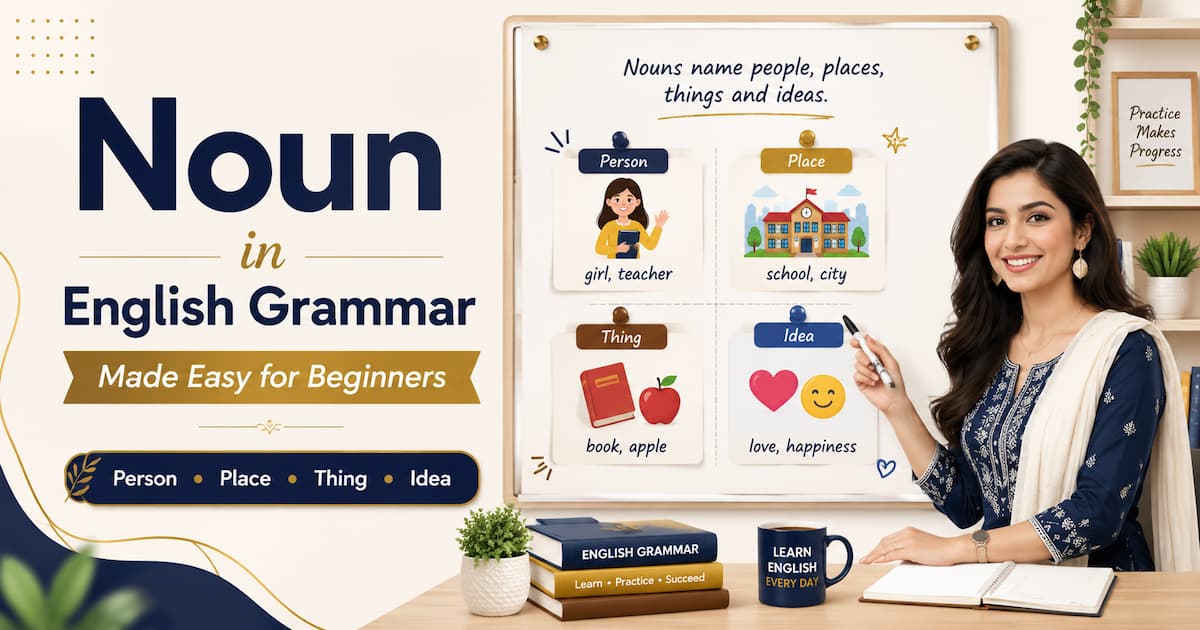
Noun in English grammar is the first and most important topic every beginner should understand. Nouns help you name people, places, things, and ideas around you. Without nouns, sentences feel incomplete and confusing.
This guide is written especially for beginners who want clear explanations, simple language, and practical examples that actually make sense. At Englishhubplus, our goal is to make grammar easy, natural, and stress-free for learners studying English at home.
What Is a Noun in English?
Many beginners ask, what is a noun in English and why it matters.
A noun is a word used to name something. It can be a person like a teacher, a place like a city, a thing like a book, or an idea like happiness. Every sentence needs a noun because it tells us who or what the sentence is about. Once you understand nouns, reading and writing English becomes much easier.
Noun in English Grammar Explained Simply
In noun in English grammar, nouns act as the foundation of sentences.
Example:
“The boy plays football.” In this sentence boy and football are nouns.
Beginners do not need to memorize difficult rules. The best way to learn nouns is by seeing them in everyday sentences. This approach builds confidence and improves understanding step by step.
Noun Examples for Beginners
Seeing real examples helps beginners learn faster. Here are some easy noun examples for beginners:
- The girl reads a book.
- My mother cooks dinner.
- The school is closed today.
- Honesty is a good habit.
These examples show that nouns appear everywhere in English. When you start noticing them, grammar feels much simpler and more familiar.
Types of Noun in English Grammar
Understanding the types of noun in English grammar helps beginners use English correctly.
1. Common Noun
A general name for a person, place, or thing.
Examples: boy, city, book.
Sentence: The boy is reading a book.
2. Proper Noun
The specific name of a person, place, or thing. Always capitalized.
Examples: Ali, London, Monday.
Sentence: Ali lives in London.
3. Concrete Noun
A noun you can see, touch, hear, smell, or taste.
Examples: table, dog, apple.
Sentence: The dog is sleeping.
4. Abstract Noun
Names an idea, feeling, or quality you cannot touch.
Examples: happiness, honesty, love.
Sentence: Honesty is important.
5. Collective Noun
Names a group acting as a single unit.
Examples: team, class, family.
Sentence: The team is playing well.
6. Countable Noun
Can be counted, singular and plural forms.
Examples: book, apple.
Sentence: One book, two books.
7. Uncountable Noun
Cannot be counted individually, no plural form.
Examples: water, rice, information.
Sentence: I need some water.
8. Singular Noun
Refers to one person, place, or thing.
Examples: cat, pen, child.
Sentence: The teacher is kind.
9. Plural Noun
Refers to more than one person, place, or thing.
Examples: cats, pens, children.
Sentence: The children are playing.
10. Possessive Noun
Shows ownership or belonging.
Examples: Ali’s book, the girl’s bag.
Sentence: This is Sara’s pen.
Learning all types of nouns helps beginners form correct sentences, understand English clearly, and gain confidence in speaking, writing, and reading.
Why Nouns Are Important for Beginners
Understanding noun in English grammar helps learners form correct sentences and express ideas clearly. Once nouns are clear, learning verbs, adjectives, and sentence structure becomes easier.
If you are learning English step by step at home, mastering nouns will support your overall progress. Read our guide on how to learn English at home.
How Beginners Can Practice Nouns Daily
- Read simple English sentences and identify nouns.
- Write short sentences daily using nouns.
- Speak basic sentences aloud focusing on nouns.
Regular practice makes nouns feel natural instead of difficult.
Conclusion
Learning Noun in English Grammar is the best starting point for beginners. Understanding what is a noun in English and practicing with simple examples makes grammar easier and more enjoyable. Englishhubplus is here to provide clear, reliable, and beginner-friendly lessons that support real progress. Keep practicing, stay consistent, and your English skills will grow naturally.
What is a noun in English grammar?
A noun is a word that names a person, place, thing, or idea. It helps form meaningful sentences.
Why should beginners focus on nouns first?
Nouns are the foundation of sentences. Learning nouns first makes other grammar topics easier to understand.
Which types of nouns are easiest for beginners?
Beginners should start with common nouns and proper nouns, as they are most commonly used and simple to understand.
Leave a Comment