
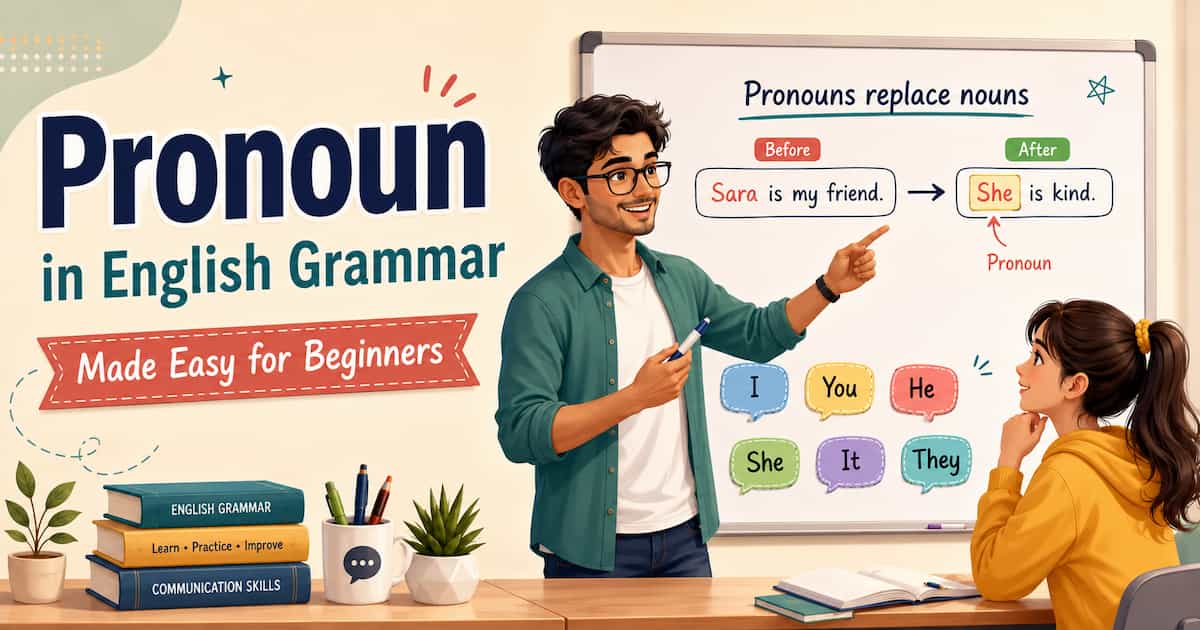
Learning Pronoun in English Grammar becomes much easier when beginners understand how pronouns replace nouns and make sentences smoother and clearer. This basic grammar concept plays an important role in speaking, writing, and everyday English communication.
A pronoun is used to avoid repetition and helps sentences sound natural. For beginners, learning pronouns step by step builds a strong foundation in English grammar.
What Is a Pronoun in English Grammar?
Many learners ask, what is a pronoun in English?
A pronoun is a word that is used instead of a noun to avoid repeating the same name or thing again and again in a sentence.
For example, instead of saying Sara is my friend. Sara is kind, we say Sara is my friend. She is kind.
Here, “she” is a pronoun. Understanding Pronoun in English Grammar helps beginners create clear and fluent sentences.
Why Pronouns Are Important for Beginners
Pronouns are essential because they make communication simple and natural. Without pronouns, sentences would sound repetitive and unnatural. Beginners who learn pronouns early can improve their sentence structure and speaking confidence.
Pronouns are used in daily conversations, stories, emails, and spoken English. That is why they are a key part of beginner grammar lessons.
Types of Pronouns in English Grammar
There are several types of pronouns in English grammar. Each type has a specific role, and learning them one by one helps beginners understand usage clearly.
Personal Pronouns
Personal pronouns refer to people or things directly. Examples include I, you, he, she, it, we, and they.
They are commonly used as subjects or objects in a sentence.
Possessive Pronouns
Possessive pronouns show ownership. Words like mine, yours, his, hers, ours, and theirs indicate possession without repeating the noun.
Reflexive Pronouns
Reflexive pronouns are used when the subject and object are the same. Examples include myself, yourself, himself, and themselves.
Demonstrative Pronouns
Demonstrative pronouns point to specific things. Words such as this, that, these, and those help identify objects clearly.
Relative Pronouns
Relative pronouns connect clauses to nouns. Common examples are who, which, that, and whom. These pronouns help form longer and more informative sentences.
Indefinite Pronouns
Indefinite pronouns refer to non-specific people or things. Examples include someone, anyone, everyone, and nothing. Beginners often see these in everyday English.
Learning these categories makes Pronoun in English Grammar much easier to understand.
Pronoun Examples for Beginners
Using examples helps beginners learn faster.
In simple sentences, pronouns replace nouns naturally and make communication smooth. Reading and practicing pronoun examples daily improves grammar skills and confidence.
Beginners should focus on identifying pronouns in sentences and using them while speaking or writing short paragraphs.
Common Pronoun Mistakes Beginners Should Avoid
Many beginners repeat nouns instead of using pronouns, which makes sentences sound unnatural. Another common mistake is mixing subject and object pronouns. Learning correct pronoun usage helps avoid these errors and improves sentence clarity.
Practicing pronouns in real-life sentences is the best way to master them.
How Pronouns Improve English Fluency
Pronouns help learners speak faster and more naturally. They reduce sentence length and make communication smooth. When beginners understand Pronoun in English Grammar, they can express ideas more confidently and accurately.
Understanding Pronoun in English Grammar is essential for beginners who want to improve their English speaking and writing skills. By learning what a pronoun is, understanding its types, and practicing examples regularly, learners can build strong grammar foundations. Englishhubplus encourages beginners to learn grammar step by step and apply it confidently in daily communication.
You can also read our beginner guide on Noun in English Grammar to understand how pronouns replace nouns:
Why are pronouns important for beginners?
Pronouns help beginners speak and write naturally by simplifying sentences and improving clarity.
Leave a Comment