
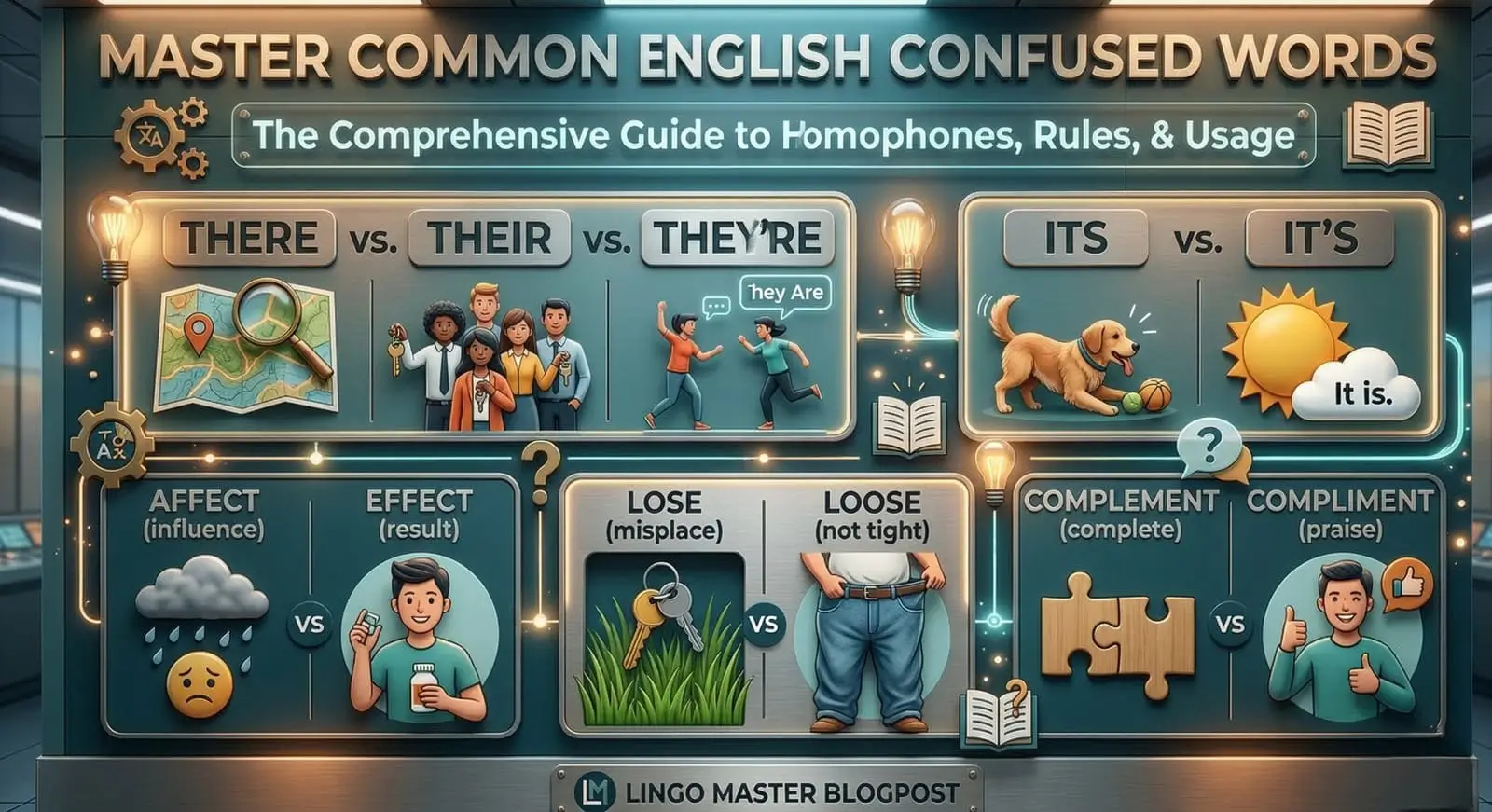
Commonly confused words in English are the silent killers of professional writing. Have you ever sent an email only to realize you used “your” instead of “you’re”? You are not alone. Millions of learners struggle with these confused words in English daily. In this comprehensive guide, we will dive deep into the world of confused words in English, providing you with the tools, examples, and rules to never make these mistakes again.
Understanding the Root Cause: Why Are There So Many commonly confused words in English?
To solve the problem of commonly confused words in English, we first need to understand why they exist. English is a language built from many sources (Latin, Greek, German, French), which leads to a massive number of homophones words that sound the same but are spelled differently. These homophones are the primary source of commonly confused words in English.
When you encounter Commonly confused words in English, your brain often chooses the word that is most “available” in your memory, rather than the grammatically correct one.
The Most Infamous Pair: There, Their, and They’re
If we look at any commonly confused words list, these three always occupy the top spots. They are the ultimate commonly confused words in English.
- There (Place/Existence): Use this to point to a location.
- Example: “Look over there!”
- Usage: It is also used with “is” or “are” (e.g., “There are many commonly confused words in English”).
- Their (Possession): Use this to show that something belongs to a group of people.
- Example: “Their house is beautiful.”
- They’re (Contraction): This is a shortened form of “They are.”
- Example: “They’re going to learn about commonly confused words in English today.”
By mastering these three, you eliminate 50% of the commonly confused words in English errors in your writing.
Expanding the List: 20 More commonly confused words in English
To make this the best commonly confused words guide, we must look beyond the basics. Here are more pairs that frequently trip up writers:
1. Its vs. It’s
This is a high-frequency entry in the commonly confused words category.
- Its: Possessive (e.g., “The dog wagged its tail”).
- It’s: Contraction of “It is” (e.g., “It’s a sunny day”).
2. Affect vs. Effect
Writers often struggle with these confused words.
- Affect: Usually a verb (to influence). “The weather affects my mood.”
- Effect: Usually a noun (the result). “The effect of the medicine was instant.”
3. Lose vs. Loose
Mixing these up is one of the most embarrassing commonly confused words in English mistakes.
- Lose: To misplace or fail to win (e.g., “Don’t lose your keys”).
- Loose: Not tight (e.g., “My shirt is loose”).
4. Complement vs. Compliment
- Complement: To complete something (e.g., “That hat complements your dress”).
- Compliment: To say something nice (e.g., “She gave me a compliment”).
Homophones Examples and Definitions: A Deep Dive
As an SEO expert, I know that people searching for commonly confused words in English also look for homophones. Let’s look at some “Homophones examples and definition” to add value to your blog.
- Definition: Homophones are words that sound alike but have different meanings and spellings.
- Example: Brake (to stop) vs. Break (to shatter). If you mix these up, you are dealing with commonly confused words in English.
- Example: Allowed (permitted) vs. Aloud (audibly).
Understanding these helps you categorize commonly confused words in English more effectively. You can even find a commonly confused words worksheet online to practice these specifically.
How to Avoid English Grammar Mistakes: Practical Tips
Now that we have identified the confused words in English, how do we stop making these errors?
- Slow Down: Most mistakes with confused words in English happen when we are in a hurry.
- Use Technology: Tools like Grammarly are excellent at catching common confused words in English.
- Keep a Journal: Write down these confused words in English that you personally struggle with.
- Learn the Etymology: Knowing the history of a word helps you distinguish it from its confused words in English counterpart.
If you are a student looking to improve, check out our modren lingo and slangs where we discuss more about commonly used words by Genz in English.
Commonly Misspelled Words in the English Language
Sometimes, common confused words in English are actually just spelling errors.
- Receive (often misspelled as recieve).
- Separate (often misspelled as seperate).
- Definitely (often misspelled as definately).
To help you stay ahead, you should check our daily vocabulary blogpost where we break down these complex patterns.
The Impact of Common Confused Words in English on Your Career
In the professional world, these confused words in English can make you look less competent. Whether it is a resume or a business proposal, precision matters. Using these confused words in English shows a lack of attention to detail.
For instance, if you are a Windows/Chrome user applying for a remote job, your written English is your first impression. Don’t let commonly confused words in English ruin it.
Conclusion: Mastering Commonly Confused Words in English
In conclusion, Commonly confused words in English are a hurdle, but not an impossible one. By studying this guide and consistently reviewing commonly confused words in English, you will become a master of the language. Remember to check your “there”, “their”, and “they’re” every time you write. Mastery of Commonly confused words in English doesn’t happen overnight, but with this 50-word guide, you are well on your way. Keep practicing, and don’t let commonly confused words in English hold you back!
Leave a Comment