
Parts of Speech with Examples help beginners understand how English actually works in real life. When we speak or write English, every word has a role to play. Many learners feel grammar is difficult only because these roles are not clear to them. Once you understand parts of speech, English becomes much easier, clearer, and more confident.
This guide explains the parts of speech in English in a simple and beginner-friendly way, using easy examples you can relate to.
What Are Parts of Speech with Examples in English?
Parts of Speech in English are categories that show how a word is used in a sentence. They help us understand whether a word is naming something, showing an action, describing something, or connecting ideas.
In simple terms, parts of speech tell us what job a word is doing in a sentence.
Why Are Parts of Speech with Examples Important for Beginners?
Learning parts of speech is important because it helps beginners:
- make correct sentences
- speak with more confidence
- write clearly
- reduce common grammar mistakes
When learners understand which word is a noun, verb, or adjective, they stop guessing and start using English naturally.
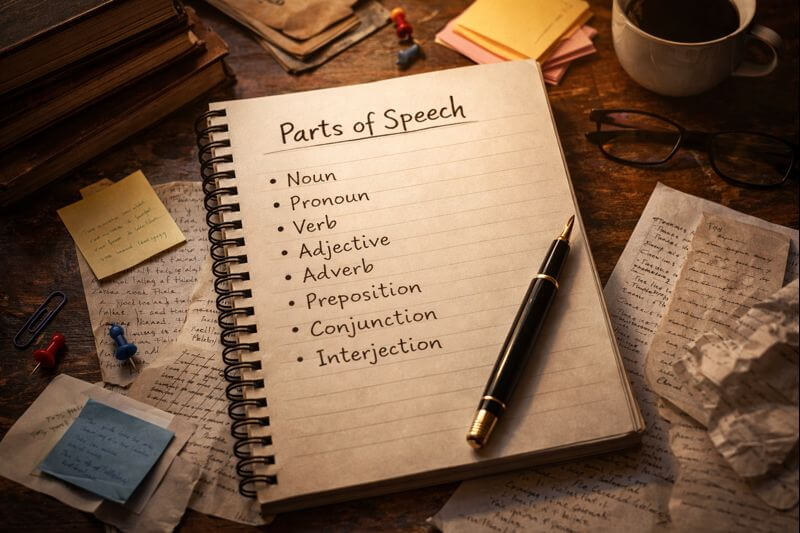
The 8 Parts of Speech with Examples
There are 8 parts of speech commonly used in English grammar. Let’s understand each one with simple examples.
1. Noun
A noun is the name of a person, place, thing, or idea.
Examples: girl, school, book, freedom
Sentence: The girl is reading a book.
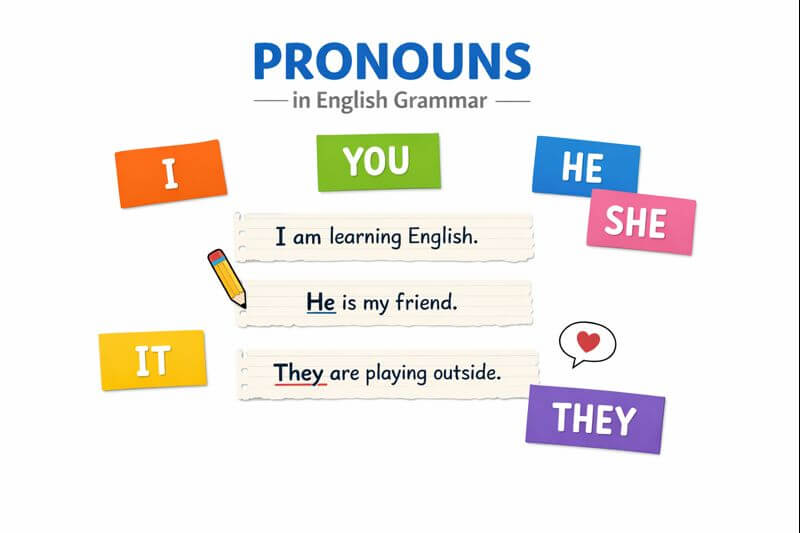
2. Pronoun
A pronoun is used instead of a noun to avoid repetition.
Examples: he, she, it, they
Sentence: She is learning English.
3. Verb
A verb shows an action or a state of being.
Examples: run, eat, learn, is
Sentence: They learn English every day.
4. Adjective
An adjective describes a noun or pronoun.
Examples: happy, small, smart
Sentence: He is a smart student.
5. Adverb
An adverb describes how an action happens.
Examples: slowly, well, confidently
Sentence: She speaks English confidently.
6. Preposition
A preposition shows the relationship between words.
Examples: in, on, under, near
Sentence: The bag is on the chair.
7. Conjunction
A conjunction joins words or sentences.
Examples: and, but, because
Sentence: I want to learn English, but I need practice.
8. Interjection
An interjection shows strong feelings or emotions.
Examples: wow, oh, great
Sentence: Wow! Your English is improving.
Common Mistakes Beginners Make
Many beginners:
- confuse adjectives and adverbs
- use verbs incorrectly
- memorize rules without practicing
The best way to avoid these mistakes is to practice using parts of speech in daily sentences while speaking and writing.
How Parts of Speech Help You Speak English Better
When Parts of Speech with Examples are clear, speaking English feels natural. You know where words belong, how to form sentences, and how to express your ideas clearly. This understanding improves both fluency and confidence. Grammar is not about fear or memorization. It is about clarity and structure.
Learning Parts of Speech with Examples is an important step for beginners who want to improve their grammar and communication skills. With simple explanations and easy examples, you can understand how words work together in sentences. Practice regularly, use English in daily life, and your confidence will grow step by step.
To improve your English faster, check out our guide on English Speaking Tips.
Why should beginners learn parts of speech first?
Beginners should learn parts of speech because they form the foundation of English grammar. Understanding them makes sentence building easier, improves speaking confidence, and reduces common grammar mistakes.
How can I practice parts of speech daily?
You can practice parts of speech by making simple sentences every day, reading short English texts, and identifying nouns, verbs, and adjectives while speaking or writing.
Are parts of speech important for English speaking?
Yes, parts of speech are very important for English speaking. When learners know where words belong in a sentence, they speak more fluently and naturally without hesitation.