
You search for ways to improve your spoken English. You click a link. And immediately, someone tries to sell you a $199 course or a monthly tutoring subscription.

Enough of that.

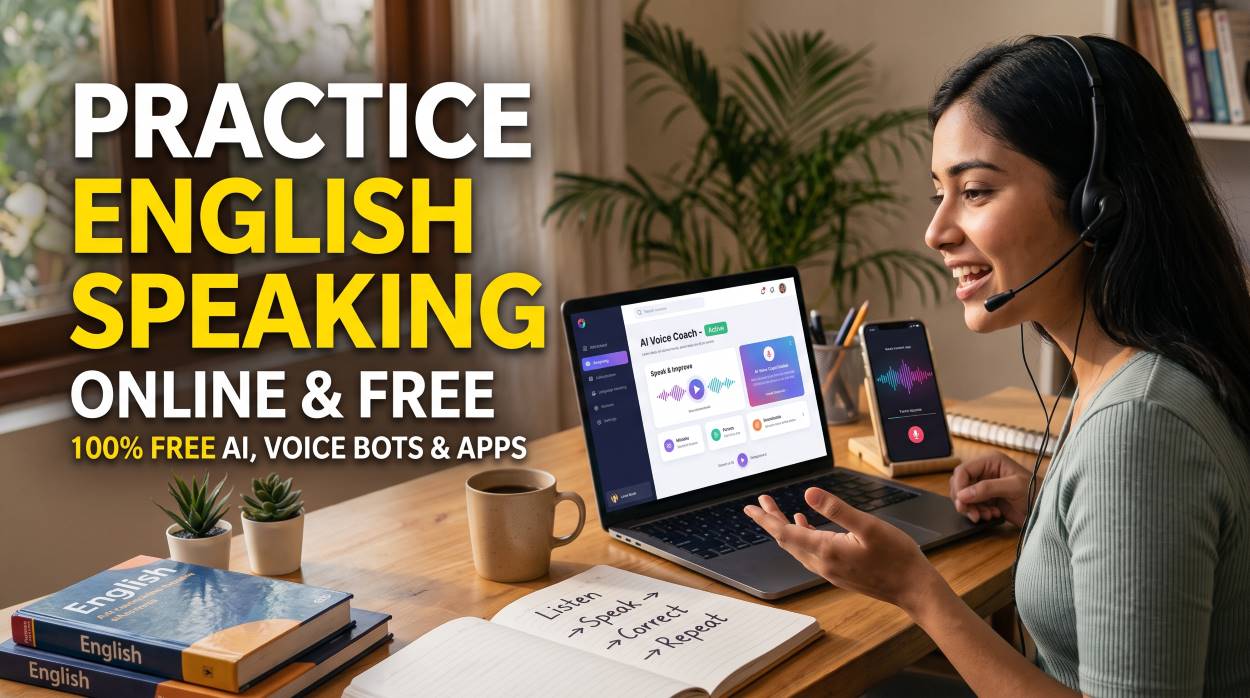
If you want to practice English speaking online free, you do not need to pay for a tutor. You do not even need a human speaking partner. In 2026, generative AI and dedicated voice apps have completely changed how we build language skills. You can simulate job interviews, test your pronunciation, and hold 30-minute daily conversations, all from your phone, and all for zero dollars.

Here is exactly how to build your fluency using the smartest free tech available right now.
Practice English Speaking Online Free AI (The Best Voice Agents)
Most learners type their questions into AI. That is a waste of technology. The fastest way to improve is using the best AI voice agents as your daily conversation partners. They do not judge your accent, they do not get tired, and they respond in real-time.

Here are the top three tools you should use:

ChatGPT Advanced Voice: This is your strict grammar coach. The advanced voice mode picks up on your tone, pacing, and grammar. You can ask it to pause and correct your sentence structure every time you make a mistake.

Pi.ai (Inflection): If you want casual, friendly speech chat, Pi is unmatched. It has a highly emotional, natural-sounding voice. Use Pi for casual daily chats, tell it about your day, complain about work, or discuss a movie. It builds your emotional fluency.

Character.ai: Need to practice for a specific real-world situation? This is where a character AI voice shines. You can talk to a simulated "Strict Job Interviewer," a "Confused Customer," or a "Friendly Barista." It forces you to think on your feet in specific contexts.
Tool Comparison at a Glance
| AI Voice Agent | Best Used For | Vibe |
| ChatGPT Voice | Grammar correction & complex debates | Professional & precise |
| Pi.ai | Casual speech chat & daily venting | Friendly & highly empathetic |
| Character.ai | Situational roleplay (interviews, ordering food) | Customizable & specific |
Practice English Speaking Online Free Without Login (Instant Websites)
Sometimes you just want to test your skills during a 10-minute break. You do not want to hand over your email address or download heavy software. If you want to practice English speaking online free without login, bookmark these two sites:
Speak & Improve (by Cambridge)
This is a brilliant, completely free research project by the University of Cambridge. A friendly AI robot named Sandi asks you a series of questions. You speak your answers directly into your browser. At the end, it instantly grades your speaking ability on the official CEFR scale (A1 to C2). It is the fastest way to get an objective score on your current level.
SpeechChat (Live TTS Hack)
SpeechChat is technically a web-based text-to-speech (TTS) client built for Twitch and YouTube live streamers. But smart language learners use it as a completely free pronunciation tool. You can open the site without logging in, type out a difficult paragraph, and have the native TTS voice read it aloud with perfect pacing. You listen, mimic the rhythm, and test your own pronunciation fluency.
Practice English Speaking Online Free With Strangers & Friends
Talking to robots is great for building confidence. Eventually, though, you need the unpredictable nature of a real human. To practice English speaking online free with strangers, skip the shady chat rooms and use moderated audio platforms.
Hilokal App: This platform hosts live audio chat rooms (voice tables) with learners from over 100 countries. You can jump into a beginner table just to listen, or grab the mic and introduce yourself. It is perfect for community practice and getting used to different global accents.
Parroto: If group settings make you nervous, Parroto matches you 1-on-1 with global peers at your exact English level. It removes the intimidation factor of talking to a native speaker and lets two learners figure it out together.
Practice English Speaking Online Free App Download (For Students & Adults)
If you prefer a structured, lesson-based approach on your phone, you need a dedicated practice English speaking online free app download. These work beautifully for both academic and professional goals.

SmallTalk2Me (For Students & Professionals)
This AI-powered platform is incredible for serious learners. It offers IELTS speaking simulations and mock job interviews. It listens to your answers and provides a detailed report on your vocabulary range, grammar mistakes, and speaking speed. If you are preparing for a university exam or a corporate interview, start here.

British Council LearnEnglish (For Adults)
The British Council offers a suite of free apps packed with self-study video lessons and interactive exercises. It is highly structured, focusing on practical, daily conversation patterns rather than obscure grammar rules.
Category 1: Best AI Voice Bots & Evaluation Tools (For Solo Practice)
ChatGPT Advanced Voice (Added): A highly responsive AI voice assistant that acts as a real-time conversational partner and strict grammar coach, instantly correcting your sentence structure.
Pi.ai (Inflection) (Added): An incredibly natural, highly empathetic AI voice bot perfect for daily casual “speech chat” and building emotional fluency without any pressure.
Character.ai (Added): Allows you to roleplay specific real-world situations (like job interviews, ordering coffee, or customer service) with highly customizable AI characters.
Speak & Improve (by Cambridge): A completely free, no-login AI research project that listens to your voice answers and instantly grades your speaking ability on the official CEFR scale (A1-C2).
SmallTalk2Me: An AI-powered platform tailored for students and professionals, offering mock job interviews, IELTS simulations, and detailed feedback on vocabulary and speed.
SpeechChat: A web-based text-to-speech (TTS) client built for live-streamers, which language learners can use as a free hack to test their reading pacing and pronunciation fluency.
ELSA Speak (Added): A specialized AI pronunciation coach that listens to your speech and provides pinpoint feedback on your accent, intonation, and specific syllable mistakes.
Category 2: Free Apps to Practice with Real People & Lessons
Hilokal: A global language exchange app featuring live audio chat rooms (voice tables) where you can practice speaking with learners from over 100 countries.

Parroto: A voice chat platform that matches you 1-on-1 with international peers exactly at your English level, removing the intimidation of big group chats.

British Council LearnEnglish: Offers a suite of free apps packed with self-study video lessons, interactive exercises, and practical daily conversation patterns.

TalkEnglish.com: Provides free, highly structured lessons covering basic, daily, and business conversation patterns to help build foundational fluency.

Free4Talk (Added): A popular browser-based community where you can instantly join free audio rooms and practice speaking English with global learners without downloading any heavy apps.
Category 3: Advanced B2B Voice AI Platforms (Developer & Enterprise)
ElevenLabs: The industry leader in AI voice generation, offering human-like realism and emotional prosody (perfect if you want to generate ultra-realistic audio to shadow).

Retell AI: A top-performing conversational voice API with incredibly low latency (~600ms) and high accuracy, built primarily for developers deploying custom voice agents.

Vapi: A developer-first AI infrastructure platform designed for building custom voice AI pipelines with complete code-level control.

Synthflow AI: A no-code voice AI platform tailored for small-to-medium businesses and agencies to deploy voice agents quickly without needing programming skills.

Bland AI: An enterprise-level platform specifically built for automating and scaling high-volume outbound sales calls and regulated operations.

PolyAI: A high-stakes, multilingual voice AI platform designed for large enterprise contact centers and customer service automation.
Smart AI Prompts & Conversation Starters (-ai)
Having an AI voice app is only half the battle. If you open ChatGPT and say, "Let's talk," the AI will probably give you a boring, generic response. You need specific conversation starters -ai prompts to force the machine into being a useful teacher.

Read this prompt out loud to your AI voice agent to set up the perfect practice session:

"Act as my native English speaking partner. We are having a casual coffee chat. Ask me one open-ended question about my life or opinions. Wait for my voice response. Before asking the next question, rate my fluency out of 10, correct any grammar mistakes I just made, and give me exactly one vocabulary upgrade. Do not break character."

This simple prompt turns a standard AI into a highly responsive, personalized English coach.
The “NotebookLM” Shadowing Hack for Pronunciation Fluency
Here is a 2026 tech hack that almost no one is talking about yet.

Google’s NotebookLM has a feature called "Audio Overviews." It takes any text you upload and generates a highly realistic, two-person podcast discussing the material.

Find an English article about a topic you love. Upload it to NotebookLM. Generate the audio podcast. Then, put on your headphones and try to speak out loud at the exact same time as the AI hosts. Try to match their pitch, their pauses, and their emotion. This technique, called shadowing, bypasses your brain's tendency to overthink grammar and directly trains your mouth-muscle memory for pronunciation AI perfection.
Daily English Speaking Practice Free (A 20-Minute Routine)
Tools only work if you actually use them. Haphazardly opening an app once a week will not build fluency. You need a fast, repeatable system. Follow this 20-minute daily English speaking practice free routine:
| Minutes | Task | Which Tool to Use |
| 0-5 | Warm-up Reading: Read a short article out loud to warm up your jaw muscles. | Any blog or news site |
| 5-10 | Shadowing: Listen to a native speaker and repeat exactly how they sound. | NotebookLM Audio or YouTube |
| 10-15 | Active Conversation: Answer an open-ended question out loud. | ChatGPT Voice or Pi.ai |
| 15-20 | Error Review: Ask the AI for feedback on your grammar and repeat the corrected sentence 3 times. | SmallTalk2Me or ChatGPT |
Stick to this loop. Five days a week. You will see a difference in 14 days.
Over to you: What is your biggest frustration when trying to speak English out loud? Do you prefer the zero-pressure environment of an AI robot, or do you think talking to real strangers on an app like Hilokal builds confidence faster? Drop your thoughts in the comments below, I read every single one. Read our multiple guides on English vocabulary building here.
FAQs (People Also Ask)
How can I practice my English speaking online free?
You can use AI voice agents like ChatGPT Advanced Voice or Pi.ai to hold real-time conversations. Alternatively, use apps like Hilokal to join free audio chat rooms with other global learners.
Which is the best app to practice English speaking online free?
For practicing with real people, Hilokal and Parroto are the best free apps. For AI-based feedback and interview prep, SmallTalk2Me is highly recommended.
How can students practice English speaking online free without login?
Students can use Cambridge’s “Speak & Improve” website to answer voice prompts and get an instant CEFR fluency grade without ever creating an account. You can also use SpeechChat to test pronunciation against a live text-to-speech engine.
Leave a Comment